Outdoor learning is not a trend — it’s a powerful, research-backed part of a well-rounded childhood. Whether your child learns at home, in a traditional classroom, or attends a full-time outdoor program, time spent in nature offers unique benefits that support growth across all areas of development. From deeper academic engagement to stronger immune systems, outdoor learning helps balance the structure of indoor environments with opportunities for movement, creativity, and connection.
No matter your educational path, here are five surprising reasons why outdoor learning is an essential piece of the puzzle.
1. Greater Academic Gains in the Long Run
If you’re worried that time spent outside might slow academic progress, you’re not alone—but the research says otherwise. Children who engage in outdoor learning become more invested in their education, demonstrate stronger social collaboration, and develop a healthier self-concept.1 In the long run, this leads to higher academic performance and better sleep habits, which directly influence success in the classroom.2
Being immersed in nature promotes curiosity, resilience, and long-term motivation — essential building blocks for lifelong learning.
2. Supports Inclusive Learning
For children who don’t thrive in traditional settings — especially neurodivergent learners — outdoor classrooms can be transformational. For children with ADHD, outdoor time is linked to improvements in attention, executive function, motivation, and emotional well-being. ³ The sensory-rich environment of outdoor learning provides movement opportunities and reduced demands for eye contact or stillness, which can significantly improve engagement and self-regulation. The unstructured, responsive environment helps all learners — including those with autism or dyslexia—connect with content in ways that make sense for them.4
3. Boosts Immune System (and Mood!): Vitamin D and More
Outdoor time isn’t just good for learning—it’s essential for health. Exposure to natural light helps regulate sleep cycles and stimulates the body’s production of vitamin D, which supports immune function and reduces the risk of autoimmune disorders.5
But the benefits go beyond biology: green spaces are proven to reduce anxiety, boost mood, and improve mental health outcomes in children and adults alike.6 The result? Healthier, more resilient learners!
4. Improved Attention Span
It was once believed that recess distracted from academics, but we now know that the opposite is true. Children who spend more time outdoors — especially in green spaces — experience improved attention, focus, and emotional regulation. Studies show that outdoor play reduces stress, increases self-discipline, and is even associated with gains in IQ.7 8
Nature literally changes the way children’s brains work!
5. Supports Imagination and Creativity
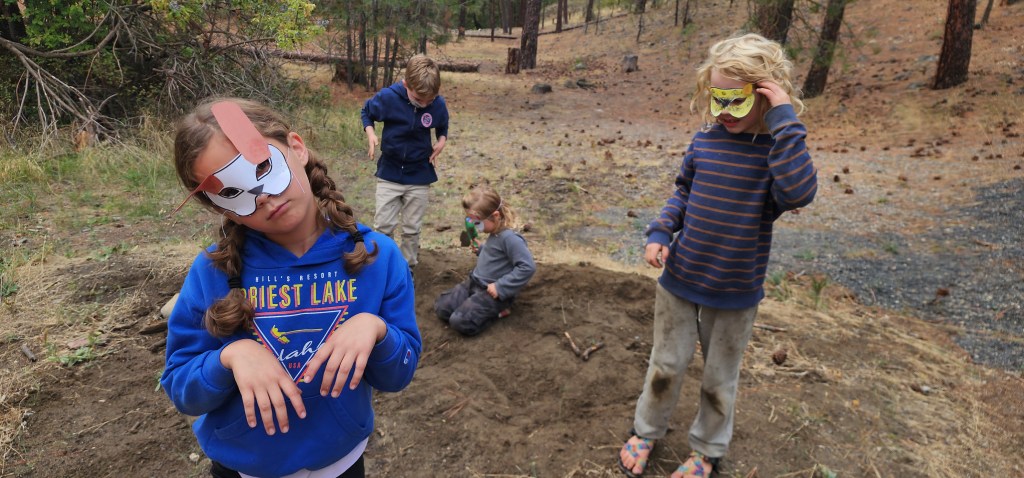
Nature doesn’t come with instructions. A stick can become a tiny bridge, a sword, or a wand. A downed tree becomes a magical narwhal to ride, a mountain to climb, or a spaceship to launch into another galaxy. Rocks become characters in elaborate stories, tiny cities on the forest floor, and lessons in physics.
This kind of open-ended play invites children to stretch their imaginations, test ideas, and invent their own games, roles, and stories. Without the predetermined use of manufactured toys, nature invites creativity to take the lead.
Outdoor learning isn’t just enrichment — it’s essential. It supports the whole child: body, mind, and spirit. Whether it’s a quiet story under the trees, a muddy math lesson, or a joyful game of forest tag, time in nature helps children thrive.
Sources
- Dankiw, K. A., Tsiros, M. D., Baldock, K. L., & Kumar, S. (2020). The impacts of unstructured nature play on health in early childhood development: A systematic review. PLOS ONE, 15(2), e0229006. https://pmc.ncbi.nlm.nih.gov/articles/PMC9149177/
- Li, H., Chen, Q., Zhu, Z., Zhao, X., Hu, Y., & Xiang, H. (2023). The effect of outdoor education interventions on students’ academic performance: A meta-analysis. BMC Public Health, 23, Article 15532. https://bmcpublichealth.biomedcentral.com/articles/10.1186/s12889-023-15532-y
- Sundberg, D. N. (2023). The impact of nature-based preschools on children’s self-regulation and academic readiness (Undergraduate honors thesis, Portland State University). https://pdxscholar.library.pdx.edu/cgi/viewcontent.cgi?article=2582&context=honorstheses
- Wang, D., & Wang, L. (2024). Effects of outdoor learning on attention and cognitive development in early childhood: A longitudinal study. Land, 13(5), 636. https://www.mdpi.com/2073-445X/13/5/636
- Aranow, C. (2011). Vitamin D and the immune system. Journal of Investigative Medicine, 59(6), 881–886. https://pmc.ncbi.nlm.nih.gov/articles/PMC3166406/
- Nationwide Children’s Hospital. (2022, May). Spending time outdoors promotes good mental health. https://www.nationwidechildrens.org/family-resources-education/700childrens/2022/05/spending-time-outdoors-promotes-good-mental-health
- Dankiw, K. A., Tsiros, M. D., Baldock, K. L., & Kumar, S. (2020). The impacts of unstructured nature play on health in early childhood development: A systematic review. PLOS ONE, 15(2), e0229006. https://indiahikes.com/blog/global-research-confirms-being-in-nature-improves-academic-performance
- Campbell, D. (2024, June 16). Green space could be even better for young brains than we realised. The Guardian. https://www.theguardian.com/society/article/2024/jun/16/green-space-could-be-even-better-for-young-brains-than-we-realised
 Riverside Forest School
Leave a comment