And Other Lessons in Belonging — By Cameo Bodey
I never really used the word “community” when I was growing up. Sure, I had many small communities — my school, the grocery store, my neighborhood — but I didn’t think of them that way. They were just places we went. In conversation, we often say “the library,” “the store,” “the park,” as if these are separate from us. But they’re not. These are not just places — they are living parts of the community, and so are we.
Since introducing the word community to the children in our care, and using it with intention and consistency, something beautiful has happened: the children have absorbed it. It has become part of their language — and more importantly, part of their thinking.
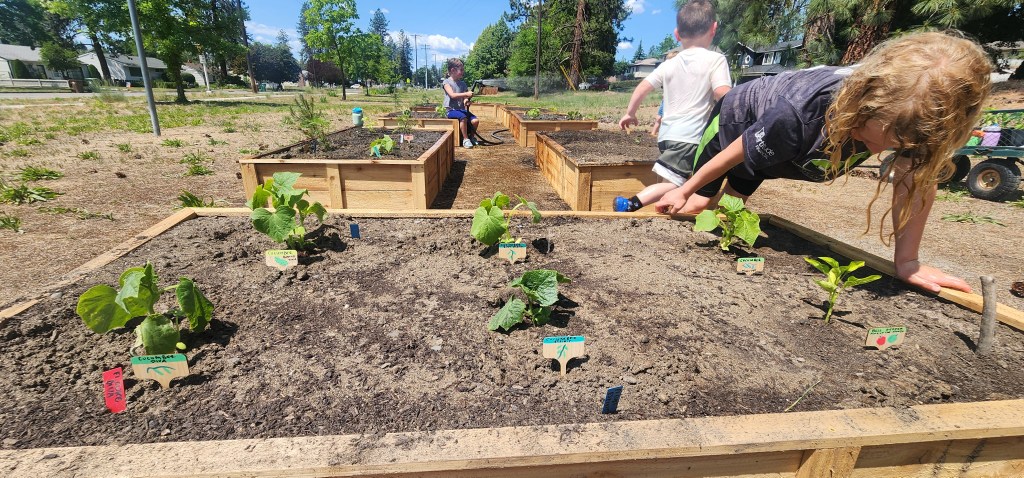
Just this afternoon, the children were digging together in the dirt. I overheard them saying “community hole,” so I asked my 6-year-old if he’d be willing to tell me more. Here’s what he said, word for word:
“We’re all working on one hole for the community. But… sometimes we get to working on it but also we also have our own individual holes which have markings that it’s OUR space. But, the community hole doesn’t have any marking because it’s the BIGGEST hole of all of them.”
This kind of language isn’t just cute — it reflects a deeply rooted understanding of what it means to belong to something greater than ourselves. The children talk about community all the time now. They think about what they’re building for their community. They make space for themselves within it. This awareness fosters connection, empathy, and a natural sense of responsibility to others — essential tools for emotional wellness, now and in the years ahead.
We’ve heard children dream up ideas like:
- Community Strawberry Garden Bed
- Community Birdhouse
- Community Magnetic Blocks Buildings
… and more!
They are learning that community is something they can build, shape, and care for.
I’m sharing this because it matters. The language we use matters. When we talk about community with children — and model what it means to participate in one — we help them grow into people who care, who contribute, and who feel they belong.
So how are you helping your child feel a sense of community?
Here are a few simple ideas to bring this awareness into everyday life:
- Visit the same grocery store, coffee shop, or library regularly? Learn the names of the staff. Greet them with kindness. Model curiosity by asking how their day is going.
- Know your neighbors? If not, start small. Take walks with your child and introduce yourself when the opportunity arises. Wave. Say hello. Connection begins with noticing.
- Use the word “community” often. Say things like: “This park is part of our community,” or “Your school is a special community, too.” Name it aloud so children begin to see the invisible web that connects us all.
- Reflect on your own community. Who are your people? Where do you belong? Share stories about the communities that shaped you.
Why Does It Matter?
Children who feel a sense of belonging are more resilient, empathetic, and emotionally secure. According to the Center on the Developing Child at Harvard1, positive social relationships and meaningful connection to others are foundational to healthy brain development and long-term mental health. A sense of belonging increases motivation, cooperation, and emotional regulation. It’s not a “nice-to-have.” It’s essential.
In a world that can often feel fractured, we’re giving children the gift of wholeness — one community hole at a time.
- National Scientific Council on the Developing Child (2004). Young Children Develop in an Environment of Relationships: Working Paper No. 1. Retrieved from www.developingchild.harvard.edu.
 Riverside Forest School
Leave a comment